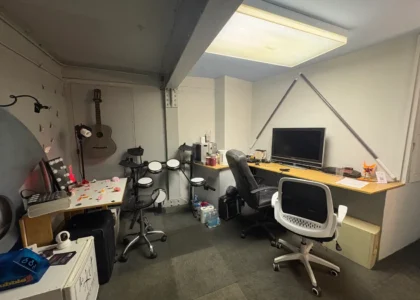


When you are looking for a PA system rehearsal room London artists can rely on, the PA is not a minor extra. It is the part of the room that lets vocals sit where they should, keys cut through a full band and everyone hear the arrangement properly. If the singer is fighting feedback or the drummer cannot hear the count-in, the session quickly becomes about surviving the room rather than improving the songs.
A good rehearsal space gives your band a usable version of the live experience, without making you spend half your booked time unpacking, troubleshooting or negotiating volume. That does not mean every rehearsal needs festival-level volume. It means the system, layout and engineer support should suit the work you are there to do.
What a PA system rehearsal room in London should provide
At a minimum, a full-band room needs a PA that can handle vocals clearly alongside drums, guitar amps, bass and any line-level sources such as keyboards, backing tracks or a sampler. The useful question is not simply, “Is there a PA?” It is, “Can our line-up rehearse without competing for audibility?”
A practical setup includes a mixer with enough channels for the people and instruments you need to put through it, properly working vocal microphones, speaker cabinets with sufficient headroom, and stands and cables that are ready to use. For many acts, that means two or more vocal mics, space for keys or tracks, and enough control over the mix to make small adjustments quickly.
Headroom matters because a PA pushed constantly to its limit sounds harsh and becomes harder to manage. It also makes feedback more likely. A system with room to breathe lets you bring the vocal forward without turning every other source up in response.
The room itself matters just as much. A PA can be technically capable but still frustrating in a cramped or poorly arranged space. You need enough room to position speakers ahead of microphones, set amps sensibly and give the drummer a clear working area. That basic layout prevents problems before they start.
A vocal PA is not the same as a full rehearsal PA
Some bands only need vocal reinforcement. Their guitar and bass amplifiers do the rest, while the PA carries lead and backing vocals, perhaps with a keyboard. This can work well for rock, indie, punk and many singer-led projects, provided the system has enough clarity for harmonies and spoken cues.
Other sessions need more from the PA. Electronic artists may need stereo playback and keys through the system. Hip-hop and R&B rehearsals may centre on vocal delivery over tracks. A function band might need multiple vocalists, playback, guitar processors and keys all balanced together. The more elements you put through the desk, the more valuable a proper channel count, sensible gain staging and a little technical knowledge become.
Be honest about the session before you book. Rehearsing new songs at low-to-moderate level has different demands from preparing a high-energy set where transitions, backing parts and vocal stamina all need testing. Neither approach is more serious. They simply call for a different setup.
Plan your soundcheck before the clock starts
The best rehearsals rarely begin with a full-volume run-through. They begin with a quick, orderly soundcheck. It need not be precious or slow, but five to ten focused minutes can save an hour of interrupted playing.
Start with the room volume. Drums are usually the acoustic reference point, especially in a compact rehearsal room. Rather than turning everything else up until it matches the kit, ask whether cymbals, amp direction and general playing level are allowing the vocals to be heard. Guitar amps pointed at players’ knees often lead to unnecessary volume. Angling them slightly towards the ears can make a dramatic difference.
Then set the vocal mics one at a time. Check that each singer can hear themselves clearly without the level sitting on the edge of feedback. Add keys, tracks or other sources afterwards, and play a section of a song together. A vocal that sounds loud enough in isolation may disappear as soon as the band starts.
Keep the first-pass mix simple. Lead vocal first, then the cues and parts that genuinely need reinforcement. If every source is competing for the front speakers, clarity disappears quickly. You can refine from there once you have played a song and identified what is actually missing.
Treat feedback as a setup issue, not a singer issue
Feedback is often blamed on how close someone stands to a microphone, but it is usually a combination of factors: speaker position, mic direction, gain, room volume and the balance of the band. Most vocal microphones reject sound from the rear, so placing speakers behind them is asking for trouble.
Avoid cupping the microphone grille, which changes the mic’s pickup pattern and can encourage feedback. Keep speakers in front of the vocal positions where possible, and do not point a live mic directly at a speaker. If a particular frequency starts ringing, reduce it carefully rather than making wholesale changes that leave the vocal dull and buried.
If you are unsure how to solve it, access to someone who understands the room and mixer is a genuine advantage. It gets you back to the music faster and helps newer artists build confidence with live sound basics.
Choose equipment that supports your actual band
A rehearsal room is most useful when its backline and PA reduce the amount you need to carry. For a full band, having drums, guitar and bass amplification, a mixer, microphones and a capable PA in place changes the practical reality of rehearsing in London. You can travel lighter, arrive ready and spend the session playing rather than building a temporary stage from scratch.
That said, supplied equipment should complement your own essentials, not force you into a setup that feels unfamiliar. A guitarist may prefer their own pedalboard, a vocalist may bring a personal microphone, and a producer-led act may need a specific playback interface. Check what is supplied, what connections are available and what you should bring before the session.
It is also worth considering whether you want to capture ideas. A rehearsal recording does not have to be release-ready to be valuable. Even a straightforward reference recording can expose a rushed chorus, a muddy backing vocal or a transition that feels clear in the room but falls apart on playback. If the song is moving beyond rehearsal, the ability to take it into a recording environment with engineering support can keep the momentum going.
Use rehearsal time for decisions, not repetition alone
A PA-equipped room gives you the chance to rehearse the parts of performance that bedroom practice cannot reveal. You can test whether a vocal arrangement still works against loud guitars, whether the intro needs a cleaner count-in, or whether a programmed element has enough impact before the first verse.
This is particularly useful before a show, a recording block or an important audition. Run the set in order at least once. Leave the gaps between songs in place. Practise tuning, track starts, pedal changes and who speaks to the audience. Those details may feel separate from the songs, but they shape how confident the performance feels.
For writing sessions, take a different approach. Keep the levels comfortable, record voice notes or rough takes, and give yourselves permission to stop when an arrangement is not working. A focused rehearsal is not always about playing a song ten times. Sometimes it is about identifying the one decision that will make the next version better.
Why the room’s working atmosphere matters
The right room should feel practical rather than intimidating. Emerging bands need space to make mistakes, tighten their sound and try ideas without feeling rushed out of the door. More established artists need reliable equipment and an environment where a serious pre-production day can stay focused.
Cartel Studios in Acton is built around that balance: equipped rooms for bands and artists, with drums, amplifiers, PA systems, mixers and microphones available alongside recording facilities when a project is ready to progress. Its West London location is useful for artists travelling from Ealing, Hammersmith, Chiswick and beyond, as well as those coming in via the A40 or M40.
The main value is not simply ticking a box for a PA. It is having a room where you can hear the work honestly. Book the space that fits your line-up, arrive with a clear goal for the session, and let the soundcheck create the conditions for a rehearsal that moves the music forward.